WHAT IS GENDER-AFFIRMING CARE?
Gender-affirming care is a broad range of support that helps transgender and gender-diverse people live as themselves, and most of it is not medical. It spans social support (like using a person's name and pronouns), psychological support (like counseling and an accepting environment), legal and practical support (like updating identity documents), and, for some people, medical care.
For young people especially, the great majority of this support is non-medical, and medical options depend on age, individual circumstances, clinical assessment, and parent or guardian involvement. It is not a single treatment, and not an automatic path toward medication or surgery. Leading US medical organizations regard this care as evidence-based and medically necessary.
Because the term is often used as if it means only hormones or surgery, it helps to see the full picture: what the care actually includes, how much of it is non-medical, who it is for, and what it is not. This page lays that out in plain language, with sources.
You may see this care described as gender-affirming care, transition-related care, or supportive care; this page mostly uses "supportive care" for clarity, and the terms describe the same thing. "Gender-affirming care" is the widely recognized and searchable name for it.
CONTENT NOTE
If your teen is in crisis or thinking about suicide, help is available right now. Call or text 988 (the 988 Suicide & Crisis Lifeline). For more, see our Where to Get Help page.
-
It's a broad landscape, not one thing. Supportive care spans social, psychological, legal, and, for some people, medical support.
-
Most of it is non-medical. Especially for children, the great majority of support is social and psychological, with no medication involved.
-
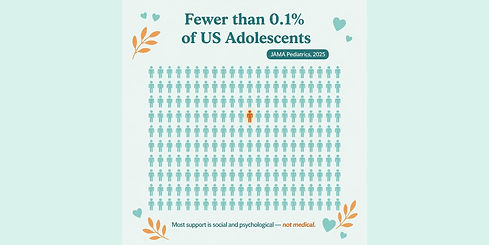
Medical care is individualized and rare for youth. Fewer than 0.1% of US adolescents in a large study received puberty-pausing medication or hormones.
-
It's not an automatic path to surgery. Supportive care is not a single treatment and does not automatically lead to medication or surgery.
-
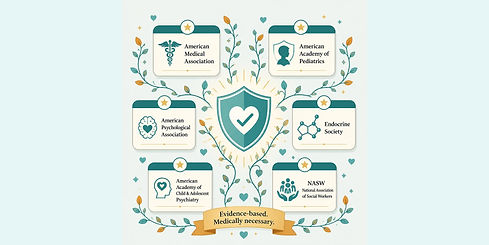
Major US medical bodies support it. The AMA, AAP, APA, and Endocrine Society regard this care as evidence-based and medically necessary.
KEY TAKEAWAYS
WHAT SUPPORTIVE CARE INCLUDES
Supportive care covers a wide landscape of support, most of which has nothing to do with medicine. Health care for transgender young people can include help with names and pronouns, family and community relationships, mental health, identity documents, and, for some people, individual medical needs. The Endocrine Society and The Trevor Project's research brief on care for youth both describe this care as a spectrum rather than a single intervention. The main categories are below.
Sources: Endocrine Society (patient guidance); The Trevor Project research brief; AAP policy (2018).
MOST OF IT IS NOT MEDICAL
For young people, the overwhelming majority of supportive care is social and psychological, not medical, and medical care specifically is uncommon.
Before puberty, there is no medical treatment at all; support at that stage is entirely social and psychological. And when it comes to medication, the numbers are small: a 2025 study in JAMA Pediatrics analyzing private insurance claims for more than 5 million US adolescents found that fewer than 0.1% were transgender or gender-diverse and received puberty-pausing medication or hormones between 2018 and 2022, and that no patient under age 12 received hormones.
Whatever the public impression, medical care is a small part of the picture, and it is reached only through assessment and, for minors, parental consent. For what non-medical support looks like, see supporting a trans child without medical steps.
WHO SUPPORTIVE CARE IS FOR
Supportive care is for transgender and gender-diverse people of any age, and it is tailored to the individual. What it looks like depends heavily on the person's age and needs: for a young child it may be entirely social, using a chosen name and supporting gender expression, while for an older adolescent it may, after careful assessment, include medical options. There is no single version of the care, because it is shaped to the individual person, their family, and their providers. Being transgender is not a mental illness, and this care is not about treating a disorder; the American Academy of Pediatrics is clear that gender-diverse identities are not pathological.
IS SUPPORTIVE CARE MEDICALLY NECESSARY?
Leading US medical and mental health organizations regard this care as evidence-based and medically necessary. The American Medical Association, American Academy of Pediatrics, American Psychological Association, and Endocrine Society regard this care as evidence-based and medically necessary and oppose government interference in these decisions. These organizations also hold that decisions about care belong with young people, their families, and their qualified providers, not with politicians.
There is genuine scientific discussion about the certainty of parts of the long-term evidence base, which independent reviews have examined. That discussion concerns how strong the evidence is, not a finding that the care is harmful, and it is covered honestly on our evidence pages, including what the research shows about safety.
WHAT SUPPORTIVE CARE IS NOT
A few common impressions of the term do not match what the care actually is.
-
It is not a single treatment. It is a wide range of support, most of it non-medical, not one procedure or prescription.
-
It is not an automatic path to medication or surgery. Social and psychological support stand on their own, and medical steps, when they happen at all, are separate, later, assessed decisions.
-
It does not medicalize young children. Before puberty, care is social and psychological only.
-
It is not one-size-fits-all. The care is individualized to the person, their age, and their circumstances.
HOW THE CARE ACTUALLY WORKS
If the question behind "what is gender-affirming care" is really "how does it work, step by step," that is a fuller topic of its own.
In short, the care is staged and individualized: it begins with support and assessment, and any medical steps follow puberty in a careful order, with families and providers involved throughout.
For the complete walkthrough, see how gender-affirming care works and for how young people are evaluated, how trans teens are assessed for care.